24 min read
Summary:
Daniel Headrick examines whether a security program is ready for Continuous Threat Exposure Management (CTEM). This article lays out five capabilities a program needs: discovering exposures, validating which ones are exploitable, prioritizing by business impact, mobilizing fixes, and scoping work to the processes where disruption would matter most. It also identifies four places where programs typically stall and proposes five metrics that measure exposure rather than activity. CTEM gives an organization a way to decide how much risk it will carry and to confirm that it stays within that limit.
RedLegg is a veteran-owned cybersecurity firm, founded in 2008, that spends its days on hands-on penetration testing, detection and response, identity, and advisory work. The approach in this post reflects that experience.
Exploitation of vulnerabilities is a rising way for attackers to get in, and remediation is not keeping pace with it.
Verizon’s 2026 Data Breach Investigations Report found exploitation at 31% of breaches where the entry point is known, now ahead of credential abuse, the previous leader, at 13%. The same report found that only 26% of the vulnerabilities on CISA’s Known Exploited Vulnerabilities list were fully remediated.
Identity has not gone away. Credential abuse is still 13% of those breaches, and the human element was present in 62% of breaches overall. Attackers tend to use whichever way in is available, and one compromised account can turn a foothold into a path to critical systems.
Exploited flaws and stolen credentials are different entry points into the same environment, so they are best managed as one picture of exposure, not in separate programs. That is the idea behind Continuous Threat Exposure Management: find the exposures an attacker could actually use, weigh them against what matters to the business, get the important ones fixed, and confirm the fixes.
This post covers the evidence for acting, what readiness requires of a program, and where programs tend to fall short. If the framework is new to you, What Is CTEM? A Practitioner’s Guide for Security Leaders covers the five stages in detail.
What Has Changed
The remediation figure from Verizon’s report has a volume side. The median organization had 50% more of those vulnerabilities to patch than the year before, and the median time to full resolution rose to 43 days from 32. Teams are not standing still. The work is growing faster than the processes built to handle it.
|
|
The timeline has compressedAn April 2026 strategy briefing from the Cloud Security Alliance, SANS, and OWASP argues that AI has collapsed the window between discovery and weaponization to hours, and that current patch cycles, response processes, and risk metrics were not built for this environment. |
For business leadership, the stakes are measurable. IBM’s 2026 Cost of a Data Breach Report puts the global average cost of a breach at $4.99 million, a record, and the US average at $11.5 million.
Why the Usual Approach Struggles
Many programs were designed around cycles that made sense when the gap between disclosure and exploitation was measured in weeks. Scans run on a schedule. Penetration tests often happen once or twice a year. Patching follows severity scores. Each of these is useful, and each answers a narrower question than the one leadership is asking, which is whether the organization is more or less exposed than it was last quarter.
Periodic testing is a snapshot. A scan or a penetration test describes the environment on the days it ran. Cloud deployments, identity changes, and new integrations keep moving in between.
Severity is not the same as exploitability. A score describes a flaw in general. It does not say whether the flaw is reachable here, whether existing controls reduce it, or what sits behind it.
Tools hold pieces of the picture. Scanners, testing, detection, and ticketing systems each hold part of the answer, and many were not built to hand work to one another.
These are the products of how security work developed, tool by tool and audit by audit. They leave three questions open: where to focus, how to prove what is exploitable, and how to make sure the right fixes happen.
What CTEM Adds
Readiness for CTEM comes down to whether a program can do five things today, and keep doing them as the environment changes.
| The Problem | What a Program Needs to be Able to Do | CTEM Stages |
| Exploitation is a rising way in | Know what is exposed, including what was not on the inventory, and which exposures are exploitable in this environment | Discovery, Validation |
| Remediation is under pressure | Rank by business impact and exploitability, then get the top items to people with the capacity to act | Prioritization, Mobilization |
| The window is hours | Run the cycle often enough for the fast-changing areas, and have detection and response ready for the time between finding and fixing | Validation, Mobilization |
| Breaches are costly | Anchor scope to the processes where disruption would matter most | Scoping |
| Tools hold pieces of the picture | Bring findings from different tools into one view that ranks by business impact and records decisions, including accepted risk | Prioritization, Mobilization |
Business risk is the thread. What ties these together is business risk. Exposure work is easier to fund, and easier to act on, when exposures are described by the business services they could disrupt rather than as counts of findings. That framing also helps security bring the business into the discussion. Security supplies the picture, and the conversation about what matters most, how much risk is acceptable, and where to invest becomes a shared one.
Two points keep this realistic. CTEM is not a promise of zero risk. It gives an organization a way to decide how much risk it is willing to carry and to see whether it is staying within that. And these requirements describe what a program can do, not which products it owns. Many organizations already have pieces of each one.
One Picture, Not Several
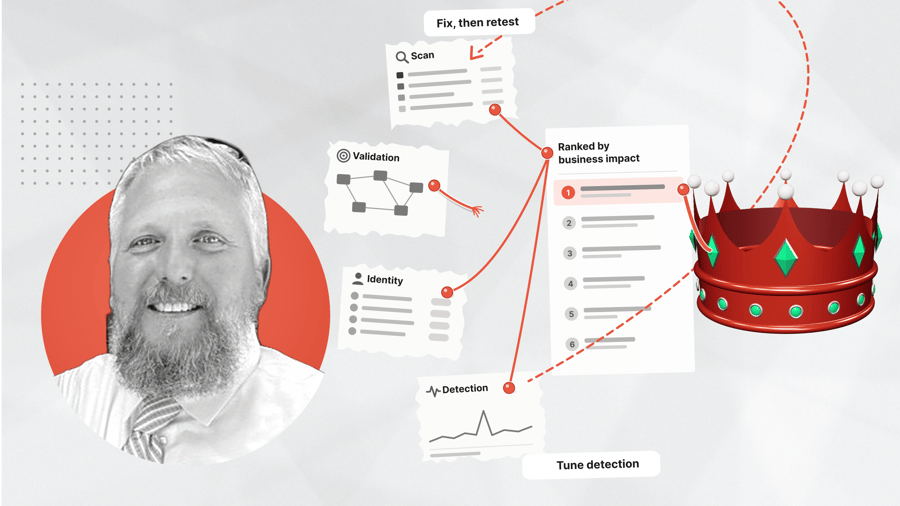
Findings that live in separate tools do not always add up to a decision. A unified approach brings them into one view, whatever mix of tools feeds it, and that changes four things. Findings from scanners, testing, identity reviews, and detection are ranked against each other instead of sitting in parallel queues. One fix can close several findings at once, instead of generating duplicate tickets for different teams. Decisions, including accepted risk, are recorded in one place with an owner and a review date. And security, IT, and the business work from the same numbers, so a trend means the same thing to each of them. Reaching a single view takes time and keeps evolving as the environment does, so it is better treated as ongoing work than a one-time project.
Where Programs Tend to Fall Short
Even programs that already run many of the pieces tend to lose momentum where one stage hands work to the next. Four patterns show up often.
Discovery finds more than anyone can sort. Inventories and scanners surface assets and findings faster than the business context needed to rank them. The backlog grows, and priority defaults to the severity score.
Testing runs on its own calendar. An annual penetration test is scoped months in advance, so the exposures at the top of this week’s list may sit outside it.
Findings arrive as reports, not as work. Without a named owner, a date, and an agreed response (fix, mitigate, or accept), a confirmed exposure waits.
Nothing flows back. A fix is not retested, detection is not told what the test showed, and scope does not change when the business does. Each cycle then starts from roughly the same place.
Closing these gaps should show up in numbers leadership can read.
Five Metrics Leadership Can Act On
Activity metrics show effort. Exposure metrics show results.
Scans completed and tickets closed describe work. These five describe exposure, and they give leadership something to act on.
- Exploitable exposure: the number of confirmed exploitable exposures on high value assets, trended over time.
- Attack paths closed: confirmed paths to critical assets that retesting shows are no longer viable.
- Verified remediation: the share of priority exposures closed and confirmed by retest, and how long that takes.
- Validation coverage: the share of high value assets and identity infrastructure tested within their defined cadence.
- Validated detection coverage: the share of validated attack paths that detection caught, or has since been tuned to catch.
Seeing Where You Stand
This companion guide turns these connections into a short set of questions across the five stages. It is a quick way to see which areas deserve a closer look first, and a useful starting point for a conversation inside your team. It is not a score.
What Comes Next
Strengthening these connections raises design questions as well as practice ones: how security, IT, and the business work through priorities together, how findings reach the work teams already do, how tools feed the stages they serve and the shared view, and where to begin. The rest of this blog series will look at how to approach them.
Stay tuned...
Learn more about how RedLegg’s services support CTEM program goals.
Frequently Asked Questions About CTEM Readiness
Readiness for CTEM is built one cycle at a time, with business risk as the thread that connects each stage. Often the most useful next step is strengthening the weakest connection rather than adding another tool.
If you would like a structured way to see which connections may need attention first, the companion guide is a good place to begin.
If you’re working through what a CTEM-aligned program looks like for your organization, we’re happy to think through it with you.
Learn more about how RedLegg’s services support CTEM program goals.