38 min read

Summary:
Continuous Threat Exposure Management (CTEM) is a structured, ongoing approach to continuously identifying where your organization is exposed to risk, validating which exposures are genuinely exploitable, and tracking how that picture changes over time. It is not a product you purchase. It is a five-stage program cycle: Scoping, Discovery, Prioritization, Validation, and Mobilization. The term was introduced by Gartner, but the underlying discipline has been taking shape across the practitioner community for years. How it gets implemented matters far more than who named it.
If you’re a CISO or security program leader trying to cut through the market noise, here’s the honest take: CTEM represents a meaningful operational shift, and it’s also a term the market has oversaturated to the point of confusion. This guide breaks down what CTEM actually requires, who’s ready for it, and what building toward it looks like in practice.
Why CTEM Matters Now: The Threat Landscape Has Changed
The attack surface has expanded well beyond software vulnerabilities. Misconfigurations, cloud identity issues, application exposures, and behavioral anomalies all create exploitable risk that point-in-time assessments miss. The Cloud Security Alliance has documented roughly 150 vulnerabilities disclosed per day, a number that continues to climb. AI-powered tooling now enables automated construction of attack chains that previously required sustained human attacker effort. For actively exploited vulnerabilities, the window between disclosure and exploitation is measured in days or hours, not weeks.
Organizations still running point-in-time remediation processes are operating on a threat model that no longer reflects current adversary behavior.
What Is CTEM? The Working Definition
At its core, CTEM answers one question on a continuous basis: where are we exposed right now, and how is that changing? A snapshot from six months ago tells you almost nothing about current risk posture in environments with cloud infrastructure, frequent deployments, or distributed identity. The continuous cadence is the point.
Three things are worth establishing clearly upfront:
CTEM is a program, not a product. Technology enables it, but people and process determine whether that technology produces remediation outcomes or just generates data. A platform running continuously with no one acting on its output is not a CTEM program. It is an alert backlog with a dashboard.
CTEM is broader than vulnerability management. Traditional VM identifies and tracks software flaws (CVEs). CTEM covers a wider surface: misconfigurations, identity risks, cloud posture, attack path chaining, and external digital risk. In many organizations, exposure management is superseding vulnerability management because the surface has grown beyond what CVE-centric programs were designed to handle.
The value is in the continuous cycle. CTEM operates as a five-stage cycle where each stage narrows the field for the next. The goal is to ensure remediation effort lands on confirmed, attacker-viable risk rather than theoretical backlogs that ignore your environment’s specific context and compensating controls.
The Five Stages of CTEM
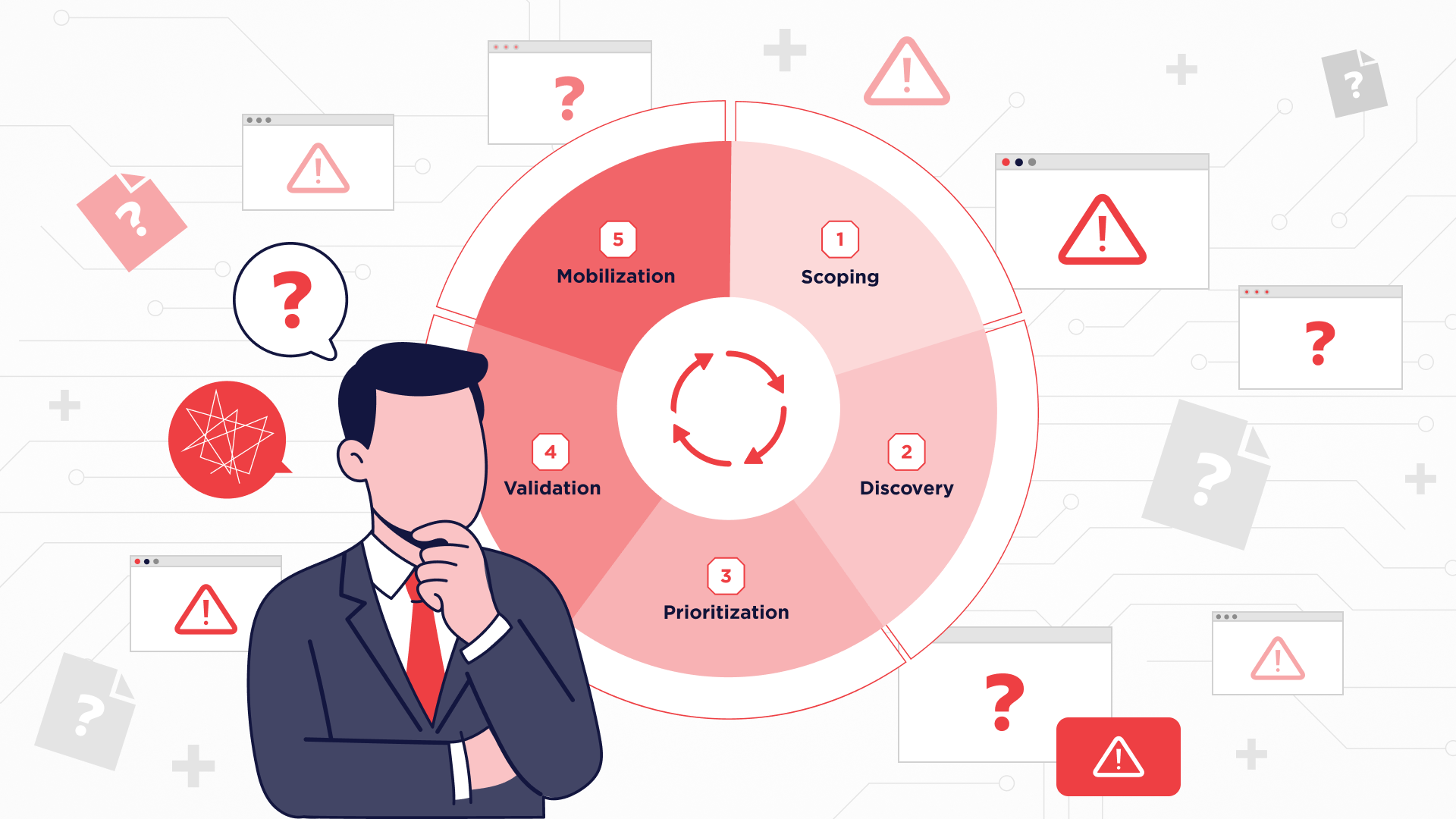
Every mature CTEM program runs these five stages continuously. They are not a one-time implementation checklist. They are a repeating cycle.
Stage 1: Scoping
Scoping defines what the program is protecting and why, anchored to business risk rather than generic asset inventories. The right questions are not technical. Which business functions, if disrupted, would create material impact? What attack types represent the most credible threats to this organization? Which assets are stakeholders actually empowered to make remediation decisions about?
Skip this stage and you end up with exposure data that has no connection to business decisions and no path to the cross-functional engagement remediation requires.
Stage 2: Discovery
Discovery maps the full attack surface within the defined scope: assets, vulnerabilities, misconfigurations, identity risks, and potential attack paths, including assets the organization does not know it has. This spans on-premises, cloud, and hybrid environments.
Automated tools handle inventory and scanning at scale. Classifying findings, correlating them with business context, and identifying what is genuinely reachable from an attacker’s perspective requires analyst effort. Treating discovery as purely automated typically produces high-volume, low-signal output that overwhelms everything downstream.
Stage 3: Prioritization
This is where most security programs break down. Finding vulnerabilities is not the hard part. Knowing which ones to fix first, given finite remediation capacity, is.
Effective prioritization goes well beyond CVSS severity scores. It incorporates:
- Exploitability: in your specific environment, not theoretical exploitability in general
- Business criticality: of the affected asset and what’s downstream from it
- Access and Reachability: across network, identity, and access controls
- Defensive Posture: existing coverage that may reduce the urgency of remediation
- Active threat intelligence: whether this vulnerability is being actively targeted right now
A critical CVE on an isolated system with compensating controls is a different problem than a medium-severity misconfiguration sitting in front of a crown-jewel application with no controls around it. Severity scores do not know the difference. Context-aware prioritization does.
Stage 4: Validation
Validation confirms that prioritized exposures are genuinely exploitable in your environment and that the controls you believe are protecting you are actually working. Techniques include adversarial simulation, red teaming, penetration testing, and attack path analysis.
This is what separates a mature CTEM program from a sophisticated scanning program. The questions the validation stage answers are operational: Can an attacker actually exploit this in our environment? Would detection catch them? Would response contain the impact before it reached something critical? It is also where the defensive posture assumptions carried into prioritization get tested. Coverage that looked adequate on paper may not hold under adversarial conditions.
Stage 5: Mobilization
Mobilization coordinates remediation across the teams actually responsible for acting on findings. Security teams typically do not own remediation. IT operations, application owners, infrastructure teams, and business units do. Getting those teams to act on prioritized findings, in the right order, within appropriate timeframes requires clear ownership, defined SLAs, and cross-functional workflow that most organizations have not fully built.
Risk reduction only occurs when the exploitable issue is actually remediated. Whether the right path is patching, a configuration change, segmentation, or accepted residual risk involves tradeoffs that require organizational judgment. AI-assisted tooling is increasingly capable of executing well-defined remediation actions, particularly in cloud environments, but the decision authority and accountability still sit with the people who own the assets and the risk.
How CTEM Relates to What You’re Already Doing
Most organizations approaching CTEM already have several of these capabilities in some form. Where programs fall short is rarely a missing tool. It is the absence of structure connecting those tools to a coherent risk picture. These are the areas where CTEM either sharpens what you already have or makes clear where the gaps are.
Risk Governance and Program Structure functions typically run on a separate track from security operations, rarely intersecting in meaningful ways. Risk registers get updated from audit findings. Board reporting reflects what compliance frameworks require. Neither tends to reflect what the environment actually looks like right now. Regulatory frameworks including NIST CSF, DORA, SOC 2, CMMC, and cyber insurance requirements increasingly demand evidence of continuous testing and ongoing risk management rather than annual checkboxes. CTEM produces that evidence as a natural output: validated findings, remediation tracking, and trend data over time. For security leaders who spend significant effort translating technical risk into board-level language, that is a meaningful shift in what they have to work with.
Adversarial Exposure Assessment anchors the validation stage of any credible CTEM program. The structured annual engagement delivers adversarial depth, complex attack chain analysis, and a formal baseline that automated tools cannot replicate. It establishes the standard the environment is held to. Continuous penetration testing maintains accountability to that standard between engagements, surfacing new vulnerabilities, configuration drift, and deployment-introduced risk before significant time passes without validated coverage. One sets the baseline. The other makes sure it holds.
Automation and Orchestration make continuous coverage operationally feasible. Automation enables discovery and testing at a frequency no human team could sustain alone. Orchestration connects the output, pulling together endpoint platforms, vulnerability scanners, external exposure tools, and assessment findings into a single exposure picture. Without orchestration, automation accelerates the production of fragmented data that never informs a decision. Without automation, the cadence continuous coverage requires is not achievable at scale. Experienced analyst review sits on top of both, ensuring findings are assessed in the context of your specific environment before driving remediation.
Threat-Informed Detection and Response exists in most organizations in some form, whether that is EDR, a SIEM, or a SOC function. CTEM changes how it gets used. Without validated attack paths, detection teams respond to generic alerts and hunt without clear direction. CTEM gives them confirmed, exploitable exposure mapped to realistic attack paths. Detection logic can be tuned to what an attacker would actually do in your environment. Response playbooks can be built around paths validation confirmed are viable. The function becomes faster, more targeted, and genuinely connected to the risk picture the rest of the program is producing.
Does Your Organization Need CTEM?
A Readiness Assessment
CTEM readiness is a spectrum. For some organizations, building toward it now is the right move. For others, the priority is shoring up foundational capabilities first. Adding continuous visibility to a program that cannot act on what it already finds does not help.
|
Signal |
Ready to Build Toward CTEM |
Foundations Come First |
|
Penetration Testing |
Structured assessments in place with continuous testing between engagements |
Haven’t tested in over a year, or no regular cadence |
|
Vulnerability Management |
Vulnerability data feeds a prioritization workflow, even if coverage is incomplete |
Vulnerabilities cataloged but not systematically prioritized or tracked to closure |
|
Asset Inventory |
Maintained asset inventory, even if incomplete |
No reliable inventory of what is in the environment |
|
Environment |
Cloud, hybrid, distributed, or SaaS-heavy |
Relatively static and on-premises |
|
Remediation Capacity |
Team and process for acting on findings |
Last assessment’s findings still untouched |
|
Workflow and Ticketing |
Findings routed through a defined workflow with ownership and SLA visibility |
Remediation tracked informally without consistent ownership or closure verification |
|
Prioritization Pain |
Volume and noise are the constraint, signal quality not finding capacity |
Known issues are finite and manageable without a prioritization framework |
|
Security Staffing |
Dedicated security function with program ownership and technical depth |
Security responsibility distributed across IT without a dedicated program owner |
|
Compliance Drivers |
Active requirements (NIST CSF, DORA, SOC 2, CMMC, cyber insurance) |
Audit-driven and checkbox-oriented only |
|
Visibility Gaps |
Blind spots between assessments and appetite to close them |
Comfortable with current point-in-time snapshot |
If most answers fall left, a CTEM-aligned program is the right next investment. If most fall right, the work is building the foundations first. The direction of travel is the same either way. The question is where you start.
What a Mature CTEM Program Looks Like in Practice
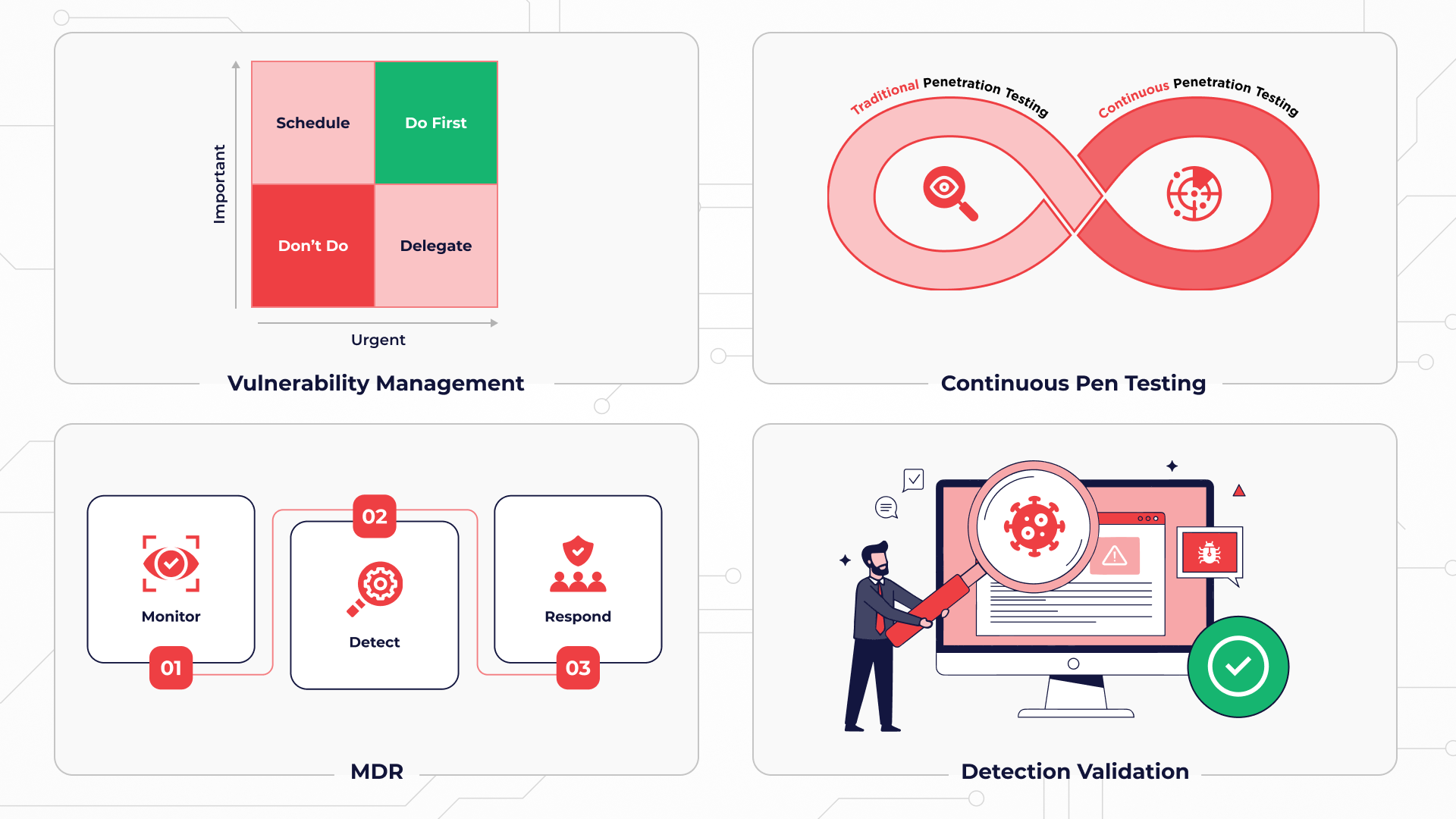
A mature CTEM program is not defined by the tools it runs or the frameworks it references. It is defined by how it operates, the decisions it makes, the questions it can answer continuously, and the organizational behaviors it produces. These are the operating characteristics that distinguish a program that is genuinely reducing risk from one that is generating activity.
It is anchored to what matters, not what is visible. Scope is defined by business risk: which assets, processes, and data would produce material impact if compromised, not by asset inventory or scanner output. Regulatory obligations and insurance requirements are built into that scoping as business risk inputs, not layered on afterward as compliance checkboxes. Evidence accumulates continuously as the program runs, so audit preparation is not a separate exercise.
It maintains a current, complete picture of the attack surface. Asset visibility, identity coverage, cloud resources, and third-party dependencies are tracked continuously, including what the organization does not know it has. The surface the program is protecting reflects what the environment actually looks like today, not at the last discovery cycle.
It validates exploitability, not just exposure. Knowing something is vulnerable is not the same as knowing it is exploitable in your environment by a realistic attacker. Full scope adversarial testing runs on a structured cadence to establish and maintain the environmental baseline. Targeted testing against identity infrastructure including Active Directory and Entra ID runs more frequently, reflecting both how quickly identity configurations change and how consistently identity-based paths feature in real attacks. High value asset testing validates the most critical assets at a cadence matched to remediation capability and business risk. Together these layers close the gap between what scanners report and what adversaries can actually do.
It knows whether its defenses work. Detection logic is tuned to validated attack paths, not generic threat categories. Response playbooks are built around confirmed adversary behavior in the specific environment, not theoretical scenarios. The program tests its own defensive assumptions regularly and updates them when validation finds gaps.
It closes exposures, not tickets. Remediation is tracked to confirmed closure with retesting, not ticket status. Findings are routed to the teams with actual ownership and authority to act, with SLAs matched to business impact. The program distinguishes between an exposure that has been fixed and one that has been accepted, and maintains that record continuously.
What these characteristics produce collectively is a program that can answer the question that matters most, at any point in time: how exposed are we right now, and is that improving?
Organizations that get real value from CTEM are not the ones that added the most tools. They are the ones that look honestly at what their program is producing, make the uncomfortable decisions about what to stop alongside what to start, and build remediation capacity at the same time as discovery capability.
Frequently Asked Questions About CTEM
What is Continuous Threat Exposure Management (CTEM) in plain language?
CTEM is a security program approach that continuously identifies where your organization is exposed to risk and tracks how that changes over time. Rather than annual snapshots, it coordinates detection, assessment, and validation into an ongoing cycle so prioritization decisions reflect your current environment, not last quarter’s scan results.
What are the five stages of CTEM?
The five stages are Scoping, Discovery, Prioritization, Validation, and Mobilization. They describe the continuous cycle the program runs through. A mature program is better understood by what it produces than by its process steps: current knowledge of what matters, what is exposed, what is exploitable, and what has been closed.
How is CTEM different from vulnerability management?
Vulnerability management identifies and tracks software flaws (CVEs). CTEM covers a broader surface: misconfigurations, identity issues, attack path chaining, and external digital risk. More importantly, CTEM adds continuous adversarial validation. Instead of a list of theoretical risks, your team works from confirmed, exploitable exposure in your specific environment.
Do I need to replace my current security tools to implement CTEM?
Not necessarily. Most organizations already have the component pieces: endpoint platforms, vulnerability scanners, external monitoring. CTEM is primarily about coordinating those tools around a unified risk picture. It often involves retiring capabilities that are not delivering meaningful signal and consolidating fragmented data sources, but it is not a rip-and-replace exercise.
What’s the biggest mistake organizations make when implementing CTEM?
Adding visibility without building the capacity to act on what it surfaces. Continuous scanning without a redesigned remediation workflow produces a larger backlog and more noise. Visibility without action capacity is a liability. The second most common mistake is scoping to assets rather than business risk, which produces technically complete programs that are protecting the wrong things.
How do I build a business case for CTEM?
The case rests on four quantifiable components: reduction in breach likelihood, compression of mean time to remediation for high-impact exposures, compliance risk reduction across active regulatory obligations, and cyber insurance positioning. Organizations that can demonstrate continuous testing and ongoing risk management rather than point-in-time assessments are increasingly better positioned on all four dimensions.
Building toward CTEM is a program decision, not a procurement decision. The right starting point depends on where your existing program has gaps, what your environment actually looks like, and how much remediation capacity you have. Not which platform has the best demo.
If you’re working through what a CTEM-aligned program looks like for your organization, we’re happy to think through it with you. Learn more about how RedLegg’s services support CTEM program goals at redlegg.com.