Continuous Threat Exposure Management
The disciplines a mature CTEM program needs, delivered as one portfolio and mapped to the phase each one serves.
GENERAL OVERVIEW
Security posture is a moving target
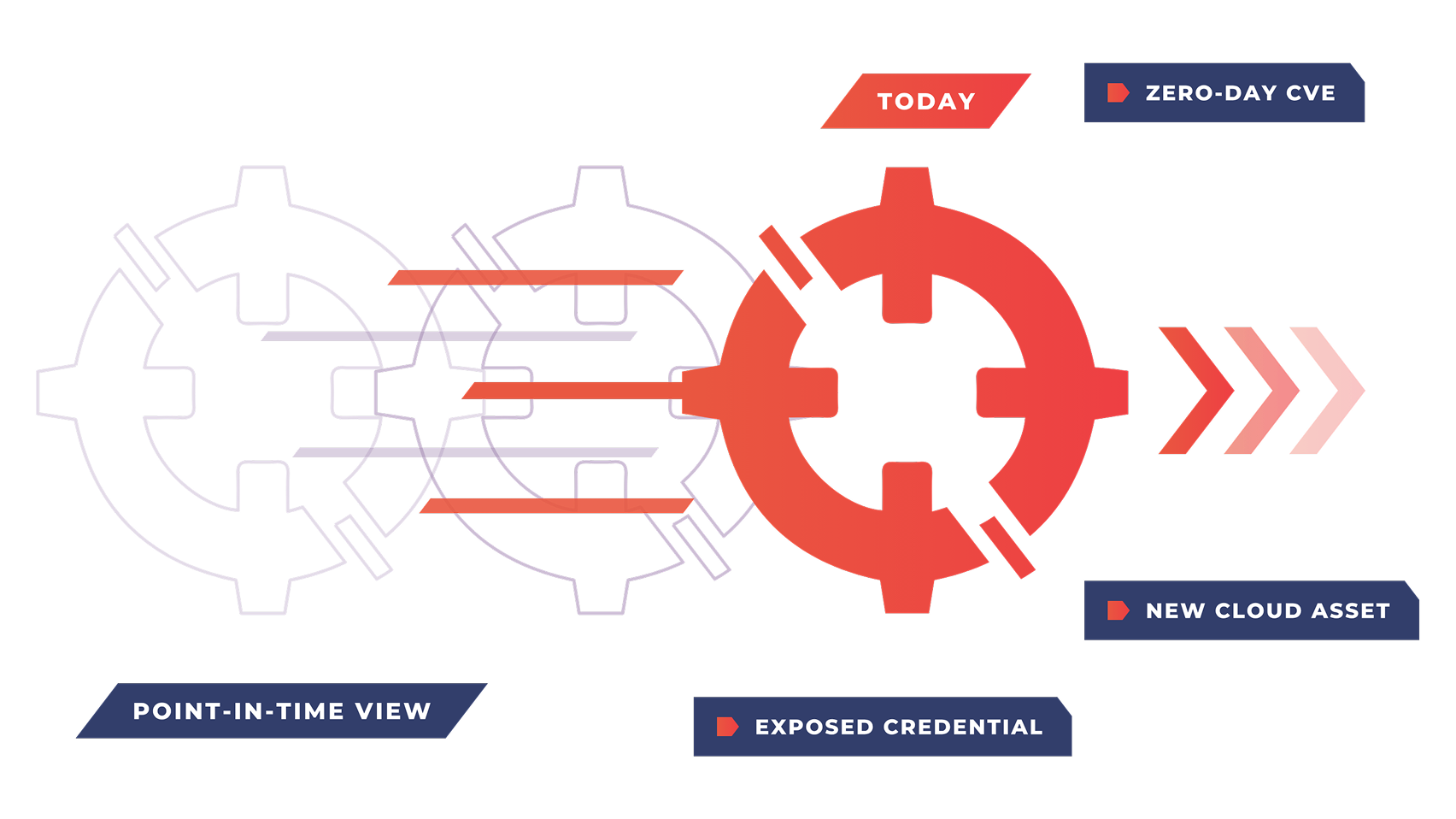
Most security programs are built around checkpoints. An annual penetration test, a quarterly scan, a periodic audit. Each one produces a clear picture of risk when it runs. The environment, meanwhile, keeps changing. Cloud services spin up, identities are granted and revoked, configurations drift, and new access paths appear between one assessment and the next. By the time a point-in-time report is delivered, the environment it describes has already moved on.
Continuous Threat Exposure Management (CTEM) closes that gap. It is a coordinated, ongoing practice that continuously answers a single operational question: where are we exposed right now, and how is that exposure changing?
RedLegg helps organizations answer that question by aligning proven security disciplines into a program that validates real exposure as environments evolve.
OUR PERSPECTIVE
How RedLegg thinks about CTEM
Exposure rarely comes from one place. It builds across users and access, systems and configurations, and daily operations, and it shifts as any of those change. No single discipline, run once, can account for it. RedLegg brings advisory, assessment, identity, and detection work together as one continuous program, guided by human judgment and backed by automation.
CTEM is a maturity model. Organizations adopt it by layering continuous testing, validation, and measurement on top of the foundations they already have.
RedLegg positions CTEM as an evolution of a mature security program, one that brings several disciplines into a single coordinated approach so exposure is understood continuously.
Each discipline in a CTEM program addresses a different aspect of exposure, and each has a distinct job. Understanding how they fit together is the key to building a program that produces clarity.
THE CYCLE
The phases of a CTEM program
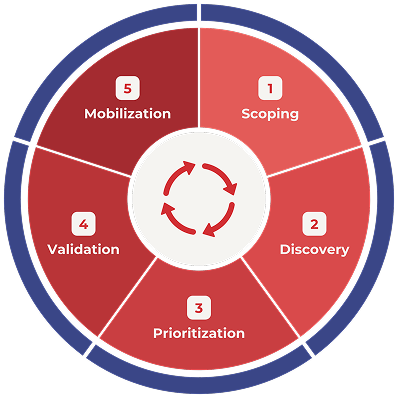
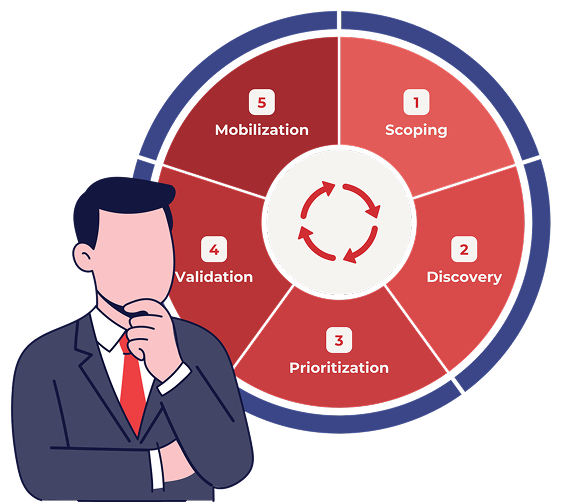
CTEM runs as a repeating cycle of five stages, with each stage narrowing the field for the next.

Scoping:
What is worth protecting?

Discovery:
Where are we exposed right now?

Prioritization:
What needs attention first?

Validation:
Can it be exploited,
and would controls catch it?

Mobilization:
Who needs to act,
and in what order?
Results from each cycle feed the next round of scoping. That loop is what makes the program continuous.
CTEM PORTFOLIO
How the RedLegg portfolio maps to the phases
Service |
Description |
CTEM Stage |
Advisory Services |
Establishes program scope, governance, and risk alignment through compliance and gap assessments, business impact analysis, and risk management program development. |
Scoping (program-wide) |
IAM Services |
Reduces identity-driven exposure through access review automation, PAM enhancements, NHI, service, and orphan account resolution, and remediation of AD and Entra ID findings. |
Discovery → Mobilization
|
Vulnerability Assessment Services |
Identifies and validates known vulnerabilities and misconfigurations across networks and systems, pairing automated scanning with human-led verification to deliver a prioritized inventory and remediation roadmap.. |
Discovery (& Prioritization) |
Traditional Penetration Testing |
Expert-led, point-in-time testing that confirms exploitability and control effectiveness, analyzes complex attack chains, and sets the baseline the environment is held to. |
Validation (& Prioritization) |
Continuous Pen Testing |
Recurring automated adversarial testing with analyst validation that holds the environment to that baseline between engagements and retests to confirm remediation.. |
Validation (& Prioritization) |
Managed Detection & Response |
24x7x365 monitoring, investigation, and response by the Cyberfusion Team, with continuous detection tuning and containment of confirmed threats through approved response actions. |
Mobilization |
Detection Validation Services (coming soon!) |
Continuously tests defensive control coverage against real adversary techniques to identify gaps and inform detection tuning. |
Validation |
WHO WE SERVE
Why organizations choose RedLegg for CTEM
Most programs don't lack security tools. They lack the structure that connects those tools to how the business manages risk. RedLegg has been a trusted, veteran-owned security partner since 2008, with years of real-world advisory, offensive security, identity, and managed detection and response experience behind every engagement. Across the portfolio, the principles are the same: build the program around business risk, bring existing tools and measurements together into one picture, and lead with human insight backed by automation.
The result is a program that gives security and business leaders a continuous, defensible understanding of where the organization is exposed, how that exposure is changing, and whether existing security investments are working as intended. Remediation effort goes where it will do the most to reduce business risk.
Start where you are.
CTEM is a progression that builds on the program you already run. Some organizations are ready to add continuous validation and better prioritization to established testing and vulnerability management. Others need to strengthen foundations first, such as asset visibility, risk governance, or remediation workflow.
RedLegg meets programs at either stage and extends internal teams with the expertise and capacity continuous exposure management requires