
.jpg?height=2000&name=shutterstock_2426977243%20(1).jpg)
Whether your stack is all CrowdStrike or CrowdStrike plus everything else, RedLegg runs it in and around your platform as one coordinated detection and response engine.
THE CHALLENGE
Your security signals don't live in one place. Endpoint says one thing, identity says another, your logs say a third. Most environments are complex. A real attack doesn't land neatly in any one of your tools. It shows up in pieces, a little in each tool, and someone has to connect those pieces by hand while the incident is live.
Even in an all-CrowdStrike stack, Falcon Insight watches your endpoints, Falcon Next-Gen SIEM watches your logs, Falcon Next-Gen Identity Security watches your identities. Three strong signals, but still three separate views of the same attack.
Whether your tools come from one vendor or five, assembling the pieces into one story is manual work, happening at the worst possible moment: mid-incident, exactly when you have no time to spare.
And correlation is only half of it. Signals from tools outside your core platform often get less attention than the ones inside it… ingested, but not tuned, not built into custom detections, not investigated with the same rigor. The source you added for coverage becomes the one nobody's engineering detections on.
A NEW WAY FORWARD
Our Cyberfusion Team correlates Falcon Platform activity against everything around it, follows the threat into identity, network, and cloud, building a full picture of the attack, and responding through SOAR in one move. Using the latest AI features we leverage CrowdStrike to accelerate our investigations and increase their efficacy. A security specialist stays in the loop 24x7x365, on the platforms you already run.
CROWDSTRIKE USE CASE
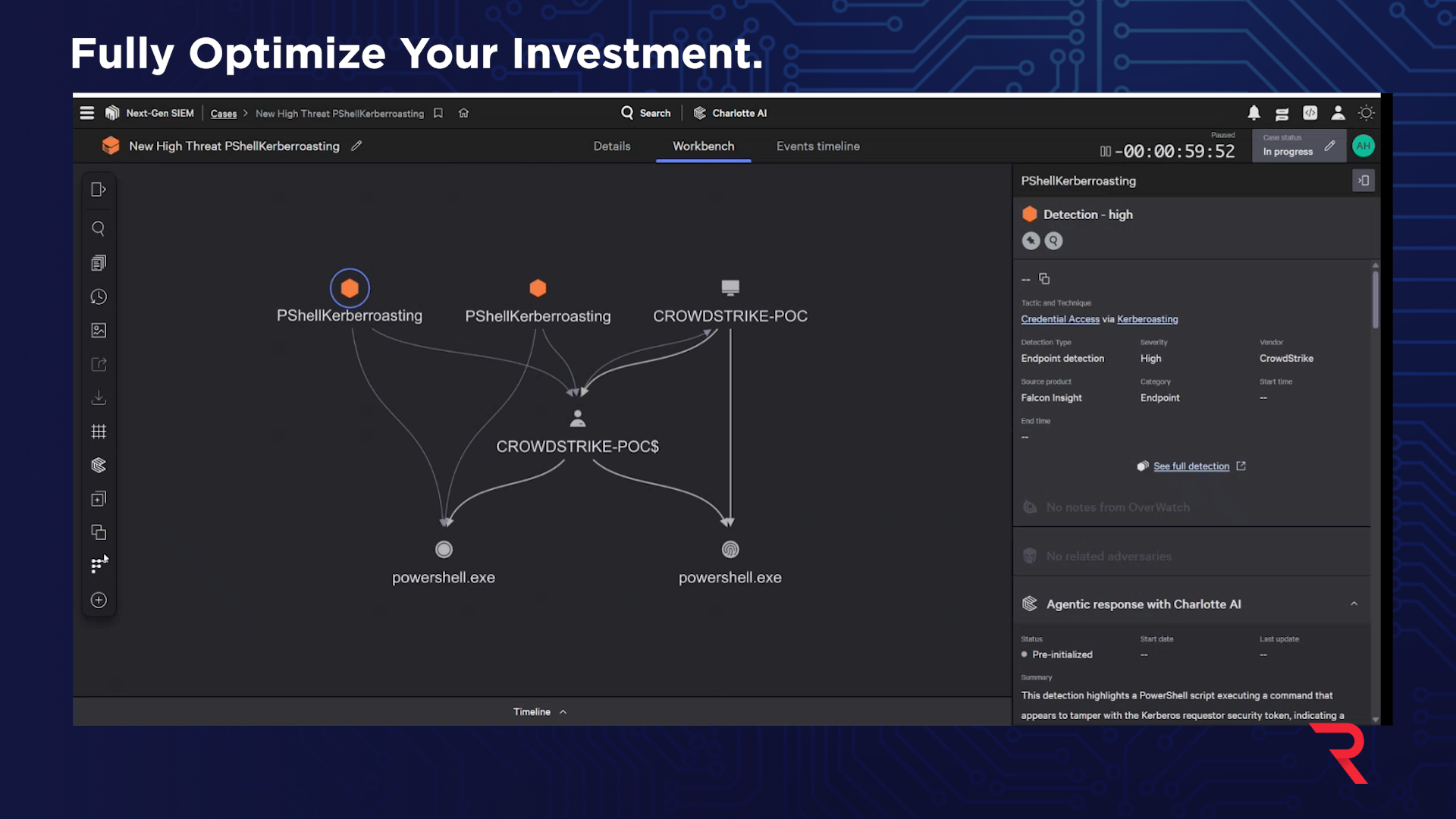
Scattered Spider moves through identity compromise, session hijacking, and fast lateral movement. For this demo, RedLegg groups Falcon Insight, Falcon Next-Gen SIEM, and Falcon Next-Gen Identity Security alerts into one case, enriches the full attack path, and gives a RedLegg analyst the complete picture before any action is taken. Once our team validates the threat and approves the response, CrowdStrike SOAR carries it out, disabling the account, revoking the sessions, and containing the host in one coordinated motion.
One coordinated response. Every layer of your CrowdStrike stack acting together.
This walkthrough runs entirely inside CrowdStrike because it's the cleanest way to see how RedLegg actually operates: one case, one validated response, one coordinated motion. Real environments are rarely this tidy, and no single demo could cover every combination of tools. That's the point. The sources change from one environment to the next, but the way RedLegg correlates them, engineers detections across them, and responds through your stack doesn't. Bring your own mix, a SIEM you already pay for, identity and cloud from other vendors, and the engine works the same.
WHY REDLEGG
In Your Platform, Not Around It
Most third-party SOC providers work from the outside in. They pull your telemetry into their stack, run detections in their own console, and respond with their own tooling, and you're left managing a second operation bolted onto the one you already own.
RedLegg works inside the platforms you already run. There's no separate console to live in, no data handed off into someone else's environment, and no second stack to maintain.